Tuesday, 18 March 2008
Mortification
A recent conversation about children and gifts brought back to me an experience from when I must have been about six. I went to the birthday party of a friend of mine, at the conclusion of which presents were given to all. I watched other children unwrapping exciting toys and games and then my present was handed to me. I eagerly tore off the paper to find - a wooden clothes hanger, painted pink, with a little picture of a robin on it. This was about as big a let-down as it was possible to have at that age. Even today I cannot imagine who thought that a six-year-old boy would be glad to get a clothes hanger (I mean, hanging up clothes at all was a completely alien concept to me), let alone one that was pink. The scars remain to this day.

Saturday, 1 March 2008
My first golf pro-am
My first golf pro-am in the mid-Eighties traumatised me so badly I didn’t play golf for ten years afterwards. Okay, the arrival of my baby daughter Kate focussed me on family matters and consumed all available cash, but the scars from that pro-am ran deep.
I was at BT at the time and had just helped to stage a very successful company golf day with a number of older British Ryder Cup stalwarts, Brian Huggett, Brian Barnes and others, helping to create an informal, chatty competition for our clients. So when I was rung up later and invited in return to a pro-am “at Fulford, up in Yorkshire”, I thought it would be another of the same. No worries. I was very much an occasional hacker, no handicap, so I wouldn’t be invited to anything serious, would I?
It wasn’t until we were driving to the course in the morning that the penny began to drop, and keep on dropping. It was indeed serious, very serious. The large yellow banners with B&H on them were a small clue. I asked the question. Oh yes, this was the pro-am the day before the Benson & Hedges International. Hadn’t I realised? So the informal group I would be playing with were? Jose Rivero, then a current European Ryder Cup star; the captain of Fulford golf club; and an important local businessman. No pressure there then. Butterflies began tap-dancing behind my navel.
As I swung on the first tee – clickclickclickclick - a fast-frame camera was firing away. I was so startled that I sent my drive straight down the fairway. Along the ground all the way, but straight. That was, I think, the only half-good shot I managed all day, and I hit a good few. It started to rain, RAF jets howled low overhead, and Jose Rivero strode along in grim silence, disgusted by his group's performance. Eighteen holes of pure unredeemed misery, ineptly hacking around in full view of the crowded galleries, a memory which even now causes me to break out into cold sweats. At the end I over-tipped my thoroughly disgusted caddie and slunk away.
Sunday, 3 February 2008
James Lee Byars piece
James Lee Byars, an American conceptual installation and performance artist, visited the National Gallery in my time there, quite what for I can't remember. He presented Alistair Smith, one of the curators, with a piece of his art, and Alistair promptly handed it on to me. The work was (is) unsigned, and consisted of a large sheet of black tissue paper folded several times down to around A5 size. I think it was a "sketch" for a larger installation. Its title, or perhaps the event for which the actual work was planned, is Four Continent Documenta (maybe done for the Documenta VII in Kassel in 1982). For the last twenty years it's been sitting in an envelope in a file at home. To frame the thing somehow seems all wrong; I know it's there, which is about all a piece of conceptual art really needs.
Tuesday, 6 November 2007
RB Kitaj - RIP
I met RB Kitaj in 1979 and 1980 when he worked on an exhibition in the Artist's Eye series at the National Gallery. He was immensely charismatic without ever being loud - you were just aware of his great force of character and thoughtfulness. What I found extraordinary about Kitaj was the depth of his knowledge and the spread of his reading. I visited his studio on one occasion and was surprised to find it piled with books. His view of the world appeared to be one of constant and complex cross-reference, and certainly the exhibition we worked on (me as designer) was one in which Kitaj laid out the works according to a language of relationships that I suspect would have been imperceptible except to a handful of extremely acute scholars. I don't know if he was married to Sandra Fisher at that time, but she too was charming. She said she wanted to do my portrait in pastels, as my colouring reminded her of the walls of Jerusalem. Sadly, as with so many things in life, I never followed this up, and Sandra died tragically early in 1994.
I have a memory of everyone calling him Kitaj, except for the the Gallery's director Michael Levey, who called him Ron. Somehow it didn't seem quite right.
I have a memory of everyone calling him Kitaj, except for the the Gallery's director Michael Levey, who called him Ron. Somehow it didn't seem quite right.
Thursday, 24 May 2007
Mivvis
Age about thirteen or fourteen*, I guess, I went off one summer's day to the sweetie shop at the bottom of Crewe Road and found there, to my great delight, a pineapple Mivvi ice-lolly, just launched. Irresistible. Licking this, I wandered back towards home and noticed that the telephone exchange on Crewe Road was having an open day, so as I had nothing better to do I went in and a large group of GPO employees gathered round and showed me all the exchange had to offer, using incomprehensible words like Strowger from time to time. So when I got home about 40 minutes later I told my brother Si that there were two exciting things he should know. One, you could now get pineapple Mivvis, and two, the telephone exchange was open and you could look around. After a while off he went too. About an hour later he got back, and I asked him how he had enjoyed the visit to the telephone exchange. "Well," he said, "it was a bit strange. The first thing they asked was 'Have you got a brother?'. I said yes, how did they know? They said, 'Well, we've only had two people in here the whole day. And both of them have been sucking a pineapple Mivvi'."
* I see from the Lyons history that the pineapple Mivvi was introduced in 1973, a long time after this when we no longer lived in Carrington Road, and I was at art college. So have I got the wrong flavour, or what?
* I see from the Lyons history that the pineapple Mivvi was introduced in 1973, a long time after this when we no longer lived in Carrington Road, and I was at art college. So have I got the wrong flavour, or what?
Sunday, 18 March 2007
Mother's Day story
Phoned my dear mother today to wish her love, and we were reminiscing about the days when my father was a teacher at Fettes College. There was a much-loved groundskeeper at the school, who died after many years of service. A few days later, two of the Fettes masters in charge of a hockey match noticed with horror that the cricket square appeared to have been vandalised in the night. Blotches of white powder were all over it. They looked, they discussed, eventually they licked a finger and had a quick taste, to try and discover what this powder was. They were still perplexed (stumped, perhaps). It was, of course the ashes of the groundskeeper, which his sons had scattered on the cricket pitch the previous evening, feeling their father would want to rest on the turf he had cared for so well.
Wednesday, 21 February 2007
Ways of Seeing and Kitaj
I re-read John Berger's book Ways of Seeing on the plane back from London recently. It lacked the extraordinary power I remember from the original television series, and as a book felt rather small and cheaply produced. Most photos are in black and white and on fairly ordinary paper. However, I enjoyed once more his thesis that the Leonardo Cartoon in the National Gallery took on a whole different meaning once an American collector had tried to buy it for a record price. It became famous for its price tag and, Berger argues, looked at and treated in a new way. On a different scale, something similar happened at the V&A while I was there. In those days London Underground published a series of destination posters, promoting places to visit by Tube. To the consternation of the V&A's sculpture department, one of these posters appeared featuring a Young Slave by Michelangelo at the V&A. The image was a charcoal sketch of the work by - I think - artist RB Kitaj, and focussed on a detail of the figure's torso. It looked marvellous, significant and bigger than life-size, and it was also delightful that London Underground were promoting the V&A.
The only problem, hence the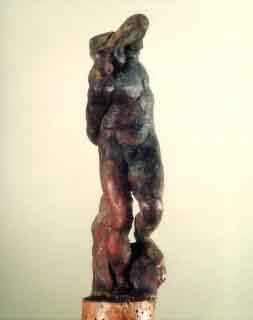 consternation, was that visitors were turning up to see this great statue, couldn't find it, and noone at the information desk knew anything about it. In fact the work was not, as it appeared from the poster, a huge prominent statue but a small blackened wax model, perhaps 15 cm high, and it was displayed in a badly-lit case with dozens of other wax models, all looking a bit like an Anthony Gormley assemblage. Kitaj had not chosen one of the museum's featured pieces but had plucked one from all-but obscurity and made it a star. He had danced with the wallflower. Somehow the V&A had now to give it the treatment. There was a hurried discussion, and the wax Slave was quickly given a case of its own, still badly lit, but at least easier to find and look at. In its new case it then took on the attributes of a signature object, one worthy of special attention. Later, it was one of the works included in an exhibition of pieces from the V&A's collection that toured North America. Like Leonardo's cartoon it took on new significance, not this time because of a price tag but because someone with an eye plucked it from the heap, and opened other eyes as well. The piece, by the way, is great. You can see the sculptor's thumbprints on it. Had I ever noticed it before Kitaj? No.
Pic courtesy of V&A
The only problem, hence the
 consternation, was that visitors were turning up to see this great statue, couldn't find it, and noone at the information desk knew anything about it. In fact the work was not, as it appeared from the poster, a huge prominent statue but a small blackened wax model, perhaps 15 cm high, and it was displayed in a badly-lit case with dozens of other wax models, all looking a bit like an Anthony Gormley assemblage. Kitaj had not chosen one of the museum's featured pieces but had plucked one from all-but obscurity and made it a star. He had danced with the wallflower. Somehow the V&A had now to give it the treatment. There was a hurried discussion, and the wax Slave was quickly given a case of its own, still badly lit, but at least easier to find and look at. In its new case it then took on the attributes of a signature object, one worthy of special attention. Later, it was one of the works included in an exhibition of pieces from the V&A's collection that toured North America. Like Leonardo's cartoon it took on new significance, not this time because of a price tag but because someone with an eye plucked it from the heap, and opened other eyes as well. The piece, by the way, is great. You can see the sculptor's thumbprints on it. Had I ever noticed it before Kitaj? No.
Pic courtesy of V&A
Wednesday, 14 February 2007
Maggi Hambling
Picking through a recently published history of the National Gallery by Jonathan Conlin, I noticed he had listed Jock McFadyen as the gallery's first artist-in-residence. In fact that honour went to Maggi Hambling, an inspired choice for this novel position. Gruff, impatient and straight-talking in the polite and slightly fey world of curatorial delicatesse, a furious smoker in a non-smoking environment, outrageous, fedora-wearing and paint-covered, Maggi at first seemed like a being from another planet when she first arrived at the gallery. Used to painting in natural light, she was of course allocated a studio space almost entirely without daylight, and instead lit mainly with spotlights. After some expletives, Maggi went on to do a series of atmospheric sketches and portrait paintings making use of the strong shadows and highlights thrown by the spots. I have a charcoal sketch from 1980 for a painting she called Mac with Shadows, which the gallery now owns. I remember wandering into her studio once and finding her with her trousers round her ankles having a pee in the sink, the loos being too far away. I of course was covered with confusion. Maggi was hooting with laughter. She was marvellous with the public, and established the role of artist-in-residence as firmly as if it had been running for a decade.
Friday, 19 January 2007
Using metaphors
I heard someone on television this morning, talking portentously about global warming, use the phrase: "lighting the fuse on a ticking time-bomb". Now, does one have to light a fuse on a time-bomb? Don't they just get set? I would have thought if it were ticking then lighting a fuse would be unnecessary; the thing was already getting ready to explode. All a bit of a muddle, metaphor-wise, and it rather masked whether what she was saying was right or not.
On a similar note, I can't watch Lord of the Rings without wincing every time archers are told to "fire". You don't "fire" an arrow (unless I suppose it is a fire-arrow); the term applies to gunpowder-based weapons, logically enough. For archers, the term is "loose" or "shoot". That's the trouble with being a pedant, you get niggled by everything.
I remember being invited to the premiere of a period film based on a Henry James novel - Michelle Pfeiffer was in it I think - with a lot of then-colleagues from the V&A. It was a good enough film in many ways, but all the way through, the art curators were whispering things like: "oh no, they never wore the collar buttoned like that," or "look at that chair, completely the wrong period, ten years later at least". So generally I keep quiet about my hair-splitting when in company.
On a similar note, I can't watch Lord of the Rings without wincing every time archers are told to "fire". You don't "fire" an arrow (unless I suppose it is a fire-arrow); the term applies to gunpowder-based weapons, logically enough. For archers, the term is "loose" or "shoot". That's the trouble with being a pedant, you get niggled by everything.
I remember being invited to the premiere of a period film based on a Henry James novel - Michelle Pfeiffer was in it I think - with a lot of then-colleagues from the V&A. It was a good enough film in many ways, but all the way through, the art curators were whispering things like: "oh no, they never wore the collar buttoned like that," or "look at that chair, completely the wrong period, ten years later at least". So generally I keep quiet about my hair-splitting when in company.
Subscribe to:
Posts (Atom)